





Company research used to be a reading problem. You pulled the filings, the contracts, the bank statements and the litigation history, and the work was simply to get through them before the deadline. The constraint was hours in the day.
That constraint has moved. A new category of AI tools will now read a data room overnight, answer two hundred diligence questions at once and cite the page each answer came from. The hard part is no longer reading. It is deciding which tool belongs in which part of the job, and knowing where each one quietly stops being reliable.
This roundup covers ten tools that are genuinely in use for company research and due diligence today — six global AI platforms, two India-specific company data providers, one data room and one free generalist. For each, the question we care about is not "what can it do" but "what can it do that the other nine cannot".
How we chose these ten
Three filters were applied.
- It must do something the others do not. A roundup of ten tools that all answer questions about PDFs is useless. Each entry here owns a distinct part of the diligence workflow.
- It must be in production somewhere serious. Every platform listed names enterprise customers, regulated-industry clients or a published user base. Nothing here is a demo.
- It must be reachable. Tools that only sell to bulge-bracket banks at six figures are included, but labelled as such, so you can skip them quickly if that is not you.
An important caveat on the numbers in this article. Coverage figures, customer counts and accuracy claims below are what each vendor publishes about itself. We have attributed them as vendor claims rather than presenting them as independently verified, because almost none of them are audited. Treat them as directional. Where a figure would actually change your decision — how many Indian companies are covered, how current the financials are — ask the vendor for it in writing during the trial.
The short version
| Tool | The one thing it is for | Realistic buyer |
|---|---|---|
| AlphaSense | What the outside world has already published about a company | Funds, corporate strategy, large advisory |
| Hebbia | Running one question set across hundreds of documents at once | PE, credit and diligence teams |
| Rogo | Turning financial data into models, memos and decks | Investment banking |
| Harvey | Legal review where privilege and audit trail matter | Law firms, in-house legal |
| Luminance | Finding the non-standard clause across a whole contract estate | Legal, procurement, post-merger integration |
| Datasite Diligence | AI that runs inside the data room, not outside it | Sell-side M&A, bankers |
| Moody's | Who ultimately owns and controls the counterparty | Banks, NBFCs, compliance teams |
| Probe42 | Indian company data as an API you feed to your own systems | Lenders, larger practices, product teams |
| Tofler | Self-serve Indian company research without a procurement cycle | CA and CS practices, SMEs |
| Perplexity | The free twenty-minute first pass before you spend anything | Everyone |
Our top recommendation
For company research as a whole, AlphaSense is the strongest single platform on this list — and it is the only one that credibly covers both halves of the job. It searches an enormous licensed library of external material and your own internal documents in the same query, and it attaches sentence-level citations to what it tells you. In a profession where every assertion has to be defensible, that last part is not a nice-to-have.
It is also expensive, quote-priced and built around listed and large private companies in developed markets. So the honest recommendation has two halves:
- If you are a fund, a corporate development team or a large advisory firm: AlphaSense first, then Hebbia when the work becomes document-heavy.
- If you are an Indian CA, CS or boutique advisory practice: start with Tofler for self-serve company research and add Probe42 when you need the same data flowing into your own systems through an API. Both will do more for your day-to-day work than any global platform on this list, at a fraction of the cost.
1. AlphaSense — the external intelligence layer
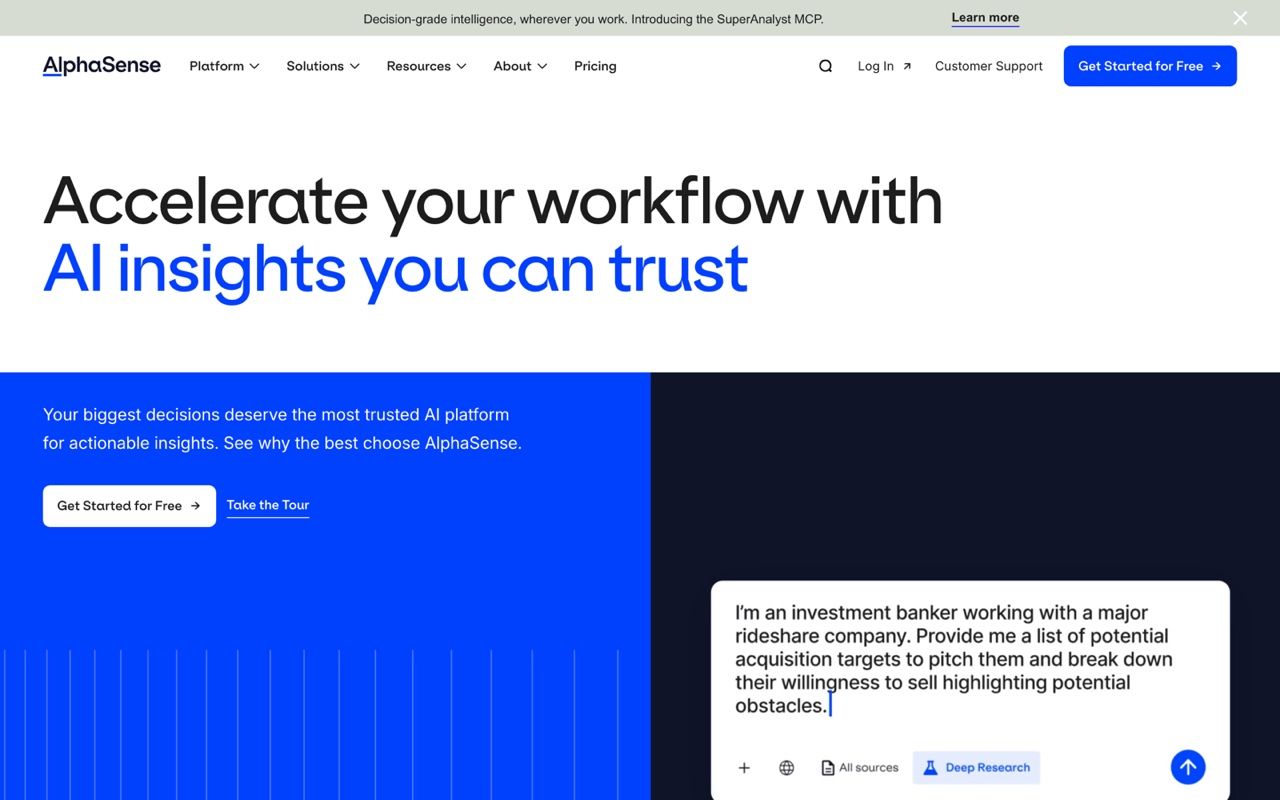
AlphaSense is a market and company intelligence platform built around search over a licensed corpus. The company says that corpus runs to more than 500 million premium financial and business documents, spanning company filings, broker research and expert call transcripts from Tegus, which it acquired. It says it serves over 8,000 enterprises.
On top of that sits an AI layer: an agent the company calls SuperAnalyst, a Deep Research mode that reasons across a chosen content set, and an MCP connector that lets other tools query the same corpus.
What makes it different: every other tool on this list reasons over documents you supply. AlphaSense reasons over documents you could not otherwise get. If the question is "what have analysts, competitors and management actually said about this company over five years", nothing else here answers it, because nothing else here has the library. The sentence-level citations matter just as much — you can click from a claim to the exact line that supports it, which is the difference between a research tool and something you can put in front of a partner.
Best for: target screening, competitive context and market diligence, where the gap is external knowledge rather than document volume.
Watch-outs: enterprise pricing with no public rate card. Coverage is strongest for listed and large private companies in developed markets; it is not the tool that will tell you about an unlisted private limited company in Pune. For that, see entries 8 and 9.
2. Hebbia — one question, hundreds of documents
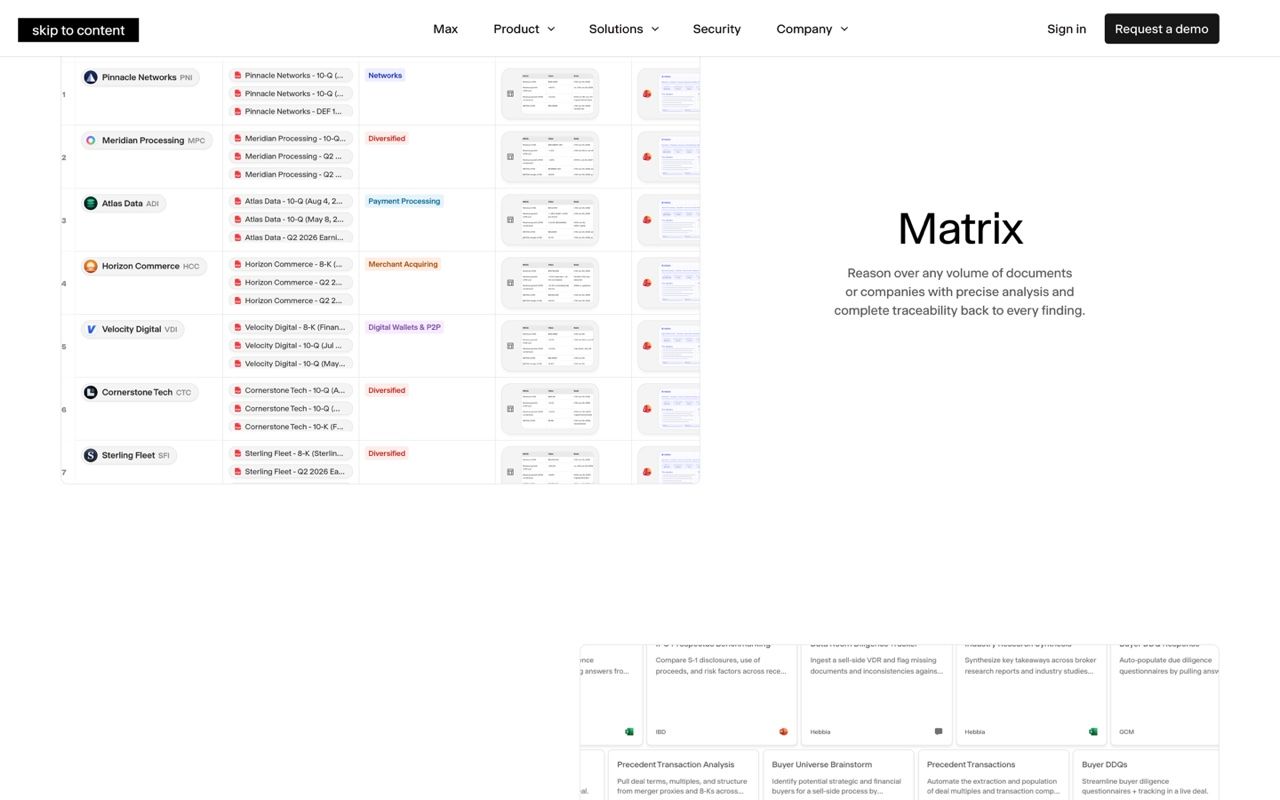
Hebbia's product, Matrix, abandons the chat window. Instead you get a grid. Rows are companies or documents; columns are the questions you want answered about each one. Fill in the grid and Hebbia populates every cell, with what the company describes as complete traceability back to every finding.
What makes it different: the interface is the differentiator, and it maps exactly onto how diligence actually works. Diligence is not a conversation. It is the same checklist applied to a hundred documents, and then an exception report. A chatbot makes you ask a hundred times. Matrix makes you ask once, down a column, and shows you the outliers side by side. Hebbia's own examples include data room diligence trackers, buyer DDQ auto-population and precedent transaction analysis — the repetitive, high-volume end of deal work.
Best for: private equity, private credit and diligence teams who already have the documents and need a structured answer set, not a summary.
Watch-outs: you supply the documents. Hebbia brings reasoning, not data. Garbage in, confidently cited garbage out — which is why the traceability feature is the one to test hardest during a pilot.
3. Rogo — built to produce the deliverable

Rogo is a finance-native AI platform aimed squarely at investment banking and investing. It says it is trusted by more than 450 institutions, used by 60,000 bankers and investors, and handles around 200,000 queries a day. Named customers on its site include Nomura, Truist Securities and Baird. It connects to OneDrive, SharePoint, Salesforce, DealCloud, FactSet and PitchBook, and runs what it describes as hundreds of purpose-built financial agents.
What makes it different: output format. The other research tools on this list hand you an answer. Rogo hands you the artefact — an LBO model as a spreadsheet, a memo, a deck. Its platform modules include Projects, Watchtower and a memory layer that keeps context from previous deals, so the firm's accumulated work becomes an input rather than a filing cabinet.
Best for: banking and investing teams whose bottleneck is producing deliverables, not finding information.
Watch-outs: this is built for the deal economy of large financial institutions. If your work is statutory audit, tax or compliance rather than transactions, almost none of it will fit.
4. Harvey — diligence where the legal standard applies
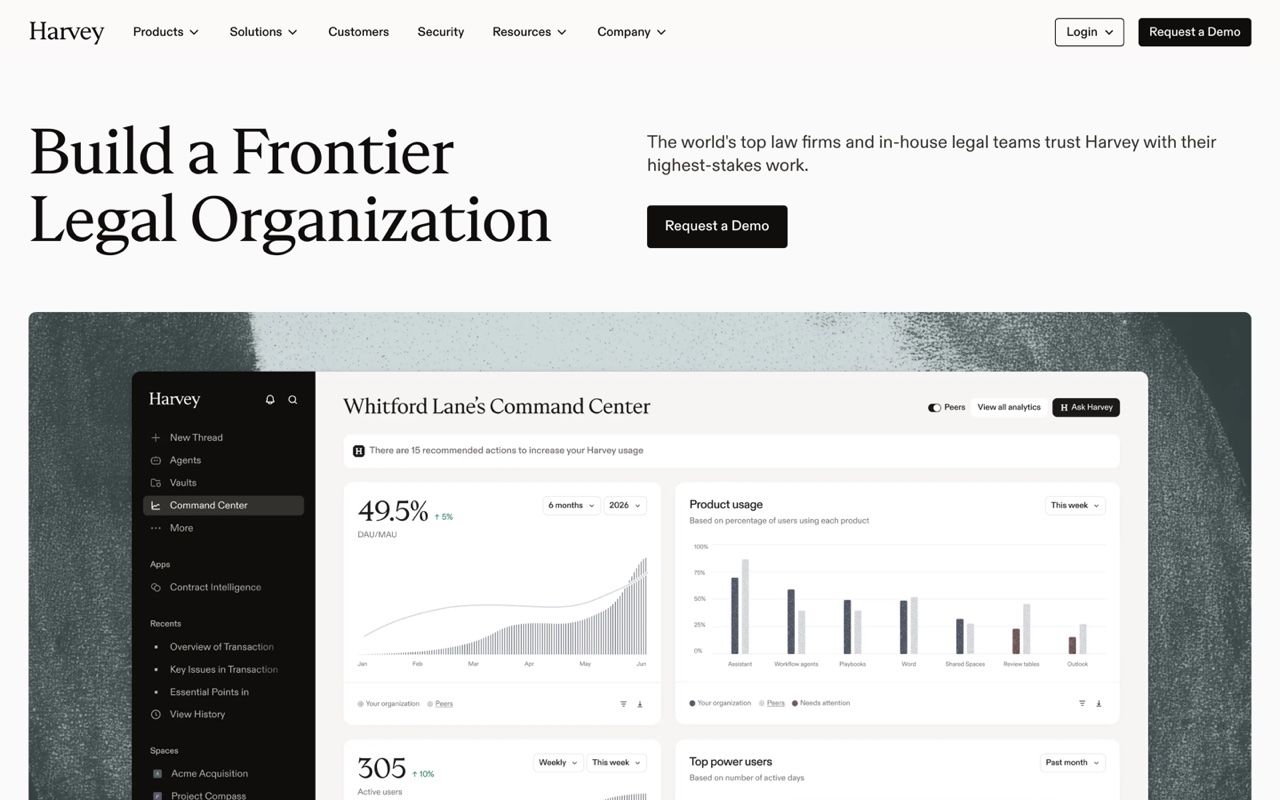
Harvey is the best-known legal AI platform. Its site reports more than 3,500 law firms and in-house legal teams, over 200,000 professionals across 85+ countries, and 80+ of the AmLaw 100. Its named products include Vault for document sets, Contract Intelligence, Agents, Knowledge, Spaces and a Command Center for usage analytics. It lists SOC 2 Type II, ISO 27001, ISO 27701 and ISO 42001 certifications.
What makes it different: the security and governance posture is the product, not the footnote. ISO 42001 is an AI management system standard specifically, and for work subject to privilege, regulatory scrutiny or client confidentiality obligations, that is often the deciding factor rather than raw capability. Harvey is also the only tool here designed around legal work product as the output — a chronology, an issues list, a contract review — rather than a financial one.
Best for: legal due diligence, contract review and any engagement where the output must survive a regulator or an opposing counsel. Useful context if you are thinking about a forensic audit engagement, where documentation standards are similar.
Watch-outs: law-firm pricing. Reported figures vary widely across secondary sources and none are confirmed by Harvey, so treat any number you read as unreliable until quoted.
5. Luminance — the contract estate, not the contract
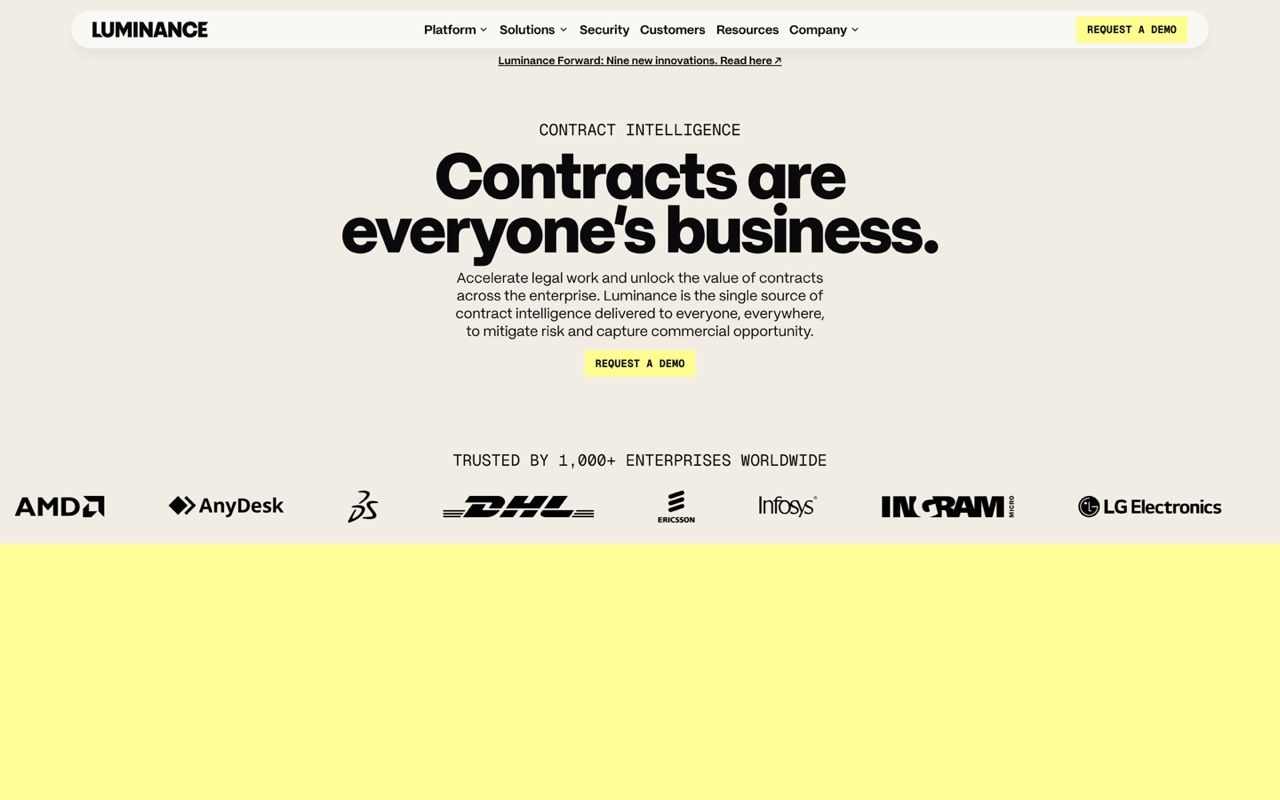
Luminance calls itself a contract intelligence platform, and says it is trusted by more than 1,000 enterprises worldwide, with customers including AMD, DHL, Ericsson, Infosys and LG Electronics. Its platform splits into Repository, Negotiation and Workflows, and it claims a 75% reduction in repetitive contract review work and more than 1.3 million contract intelligence questions answered.
What makes it different: Luminance is built to find what you did not think to ask about. Tools that answer questions only surface issues you anticipated. Luminance reads an entire contract set and flags what deviates from the pattern — the one supply agreement with an unusual termination right, the three leases with a different indexation clause. In acquisition diligence, the material risk is usually an anomaly, not a missing standard clause, and anomaly detection across thousands of agreements is a different technical problem from question answering.
Best for: contract-heavy diligence, post-merger integration and procurement reviews where the volume is in the thousands.
Watch-outs: this is a contracts tool. It will not read your financials, and it is overkill for a target with forty agreements.
6. Datasite Diligence — AI that never leaves the data room
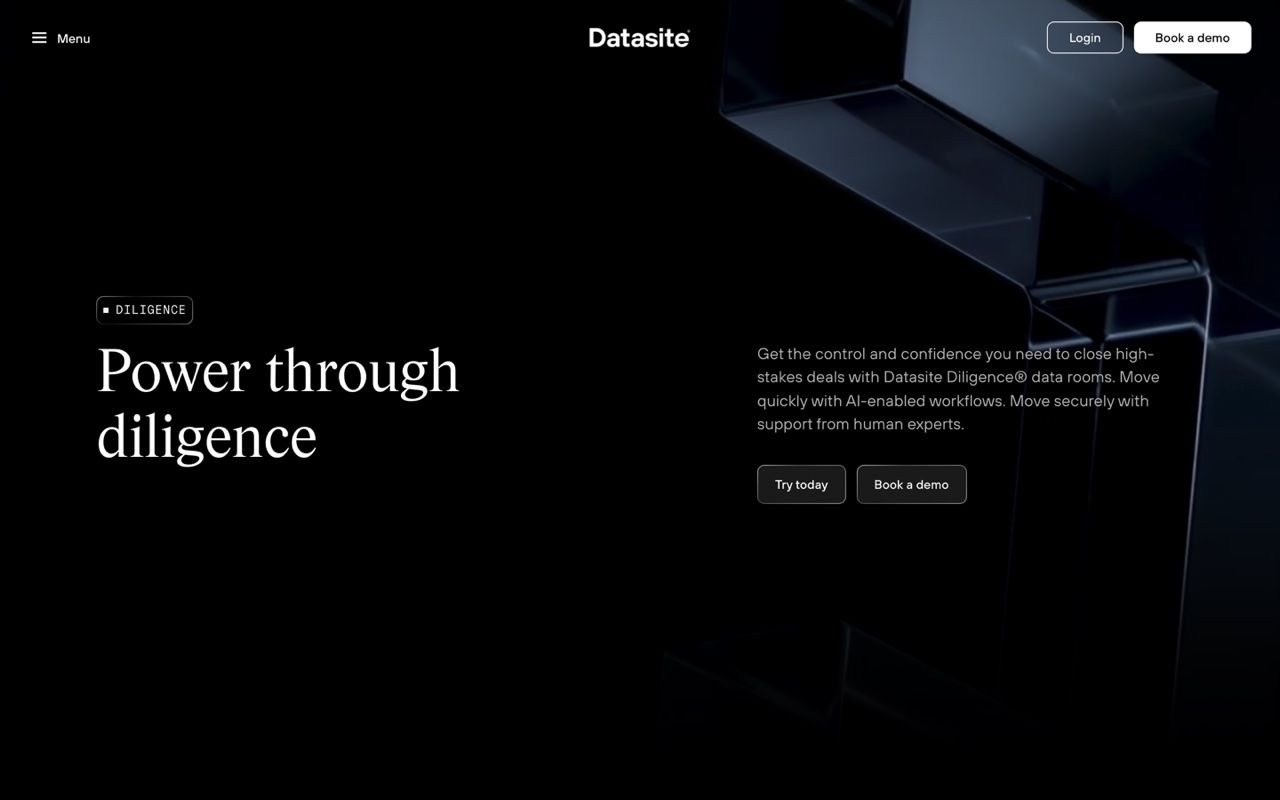
Datasite is one of the established virtual data room providers for M&A, and it has built AI directly into the room rather than alongside it. Its diligence product includes a redaction tool that Datasite says detects more than 120 types of sensitive information, a Q&A assistant that drafts answers with citations linked to the source document, a Similar Questions feature that flags duplicate buyer queries, plus Enhanced Review for side-by-side comparison, Summarize, Explain This and document translation across 17+ languages. Datasite says it is the first data room provider to achieve ISO/IEC 42001 certification.
What makes it different: the AI inherits the data room's permission model. Responses are scoped to what each buyer is actually allowed to see, and nothing is copied out to a separate platform to be processed. On a live sell-side deal with multiple bidders under different NDAs, that containment is not a feature — it is the only way the AI is usable at all.
Best for: sell-side processes where you are already running a data room and want the AI inside the perimeter.
Watch-outs: you are buying a data room, with AI attached. If you do not need the room, this is the wrong entry point, and VDR pricing is structured around deal size and duration rather than seats.
7. Moody's — who actually owns the counterparty
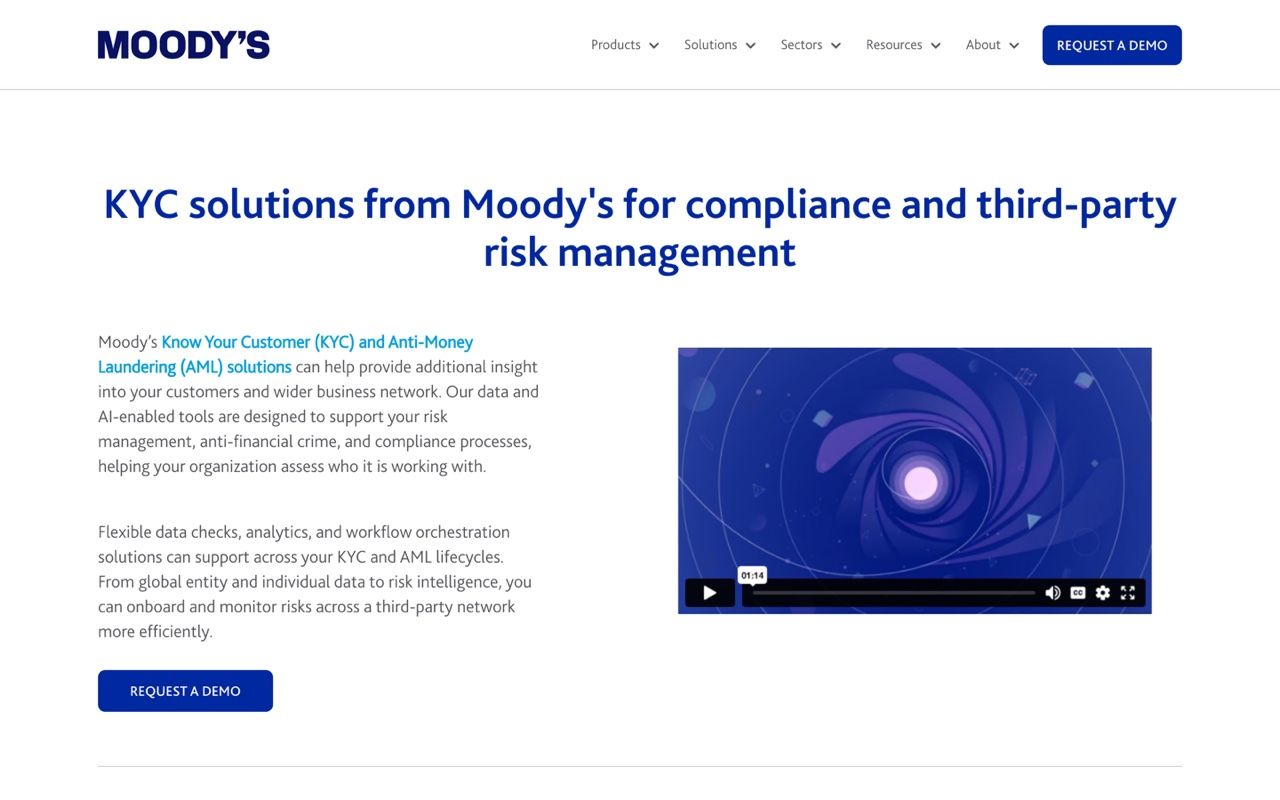
Moody's compliance and KYC suite is the entity-resolution entry on this list. Across its products — Orbis for company reference data, Grid for screening, Sanctions360, an Entity Verification API, a Shell Company Indicator and the Maxsight platform — it reports coverage of more than 650 million entities, over 31 million curated risk profiles including more than 7 million politically exposed persons, across 200+ countries and jurisdictions. It says its KYB data is drawn from live connections to corporate registers, financial authorities and tax offices globally.
What makes it different: it answers the ownership question across borders. Any single-country registry tells you who the registered directors are. It cannot tell you that the Singapore holding company's shareholder is a Mauritius entity controlled by a sanctioned individual. Beneficial ownership tracing through multi-jurisdiction structures is what this tier of provider exists for, and no amount of document AI substitutes for it.
Best for: banks, NBFCs and compliance functions onboarding entities with cross-border structures — and anyone whose diligence has to stand up to AML scrutiny. If your work touches related party transaction identification, this is the data layer that makes it tractable.
Watch-outs: enterprise contracting and an enterprise price. For a purely domestic Indian engagement, the next two entries are far better value.
8. Probe42 — Indian company data, built as an API
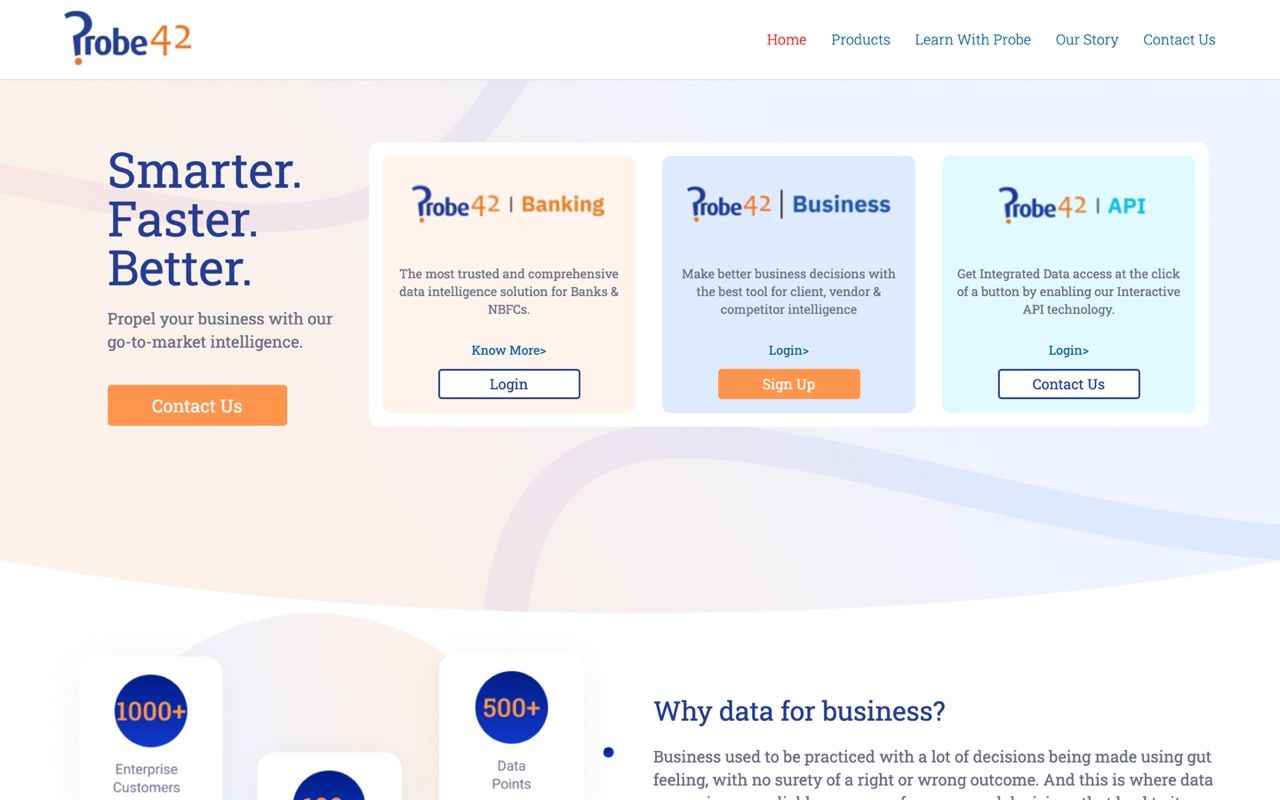
Probe42 is an Indian company intelligence provider aimed at banks, NBFCs and businesses. Its site says it collects from 743 validated public domain sources, covers 17 lakh active unlisted companies, and runs a five-step verification process supported by more than 200 data curators. It sells in three shapes: Probe42 Banking, Probe42 Business, and Probe42 API.
What makes it different: the API. Probe42 is the entry on this list most likely to disappear into your own infrastructure. Rather than another dashboard someone has to remember to open, it feeds verified MCA-derived data — financials, charges, directors, compliance status — directly into your onboarding workflow, your credit model or your own AI tooling. For a practice building any kind of internal automation, structured data through an API is worth more than a prettier interface.
Best for: lenders, larger practices and anyone who wants Indian company data as an input to a system rather than a report to read. Pairs naturally with the kind of accounting automation work practices are already doing.
Watch-outs: be clear-eyed about the category. Probe42 does not market itself as an AI product, and its site describes no AI features. It is a high-quality structured data source — which is precisely what makes it useful with AI, and precisely why you should not expect it to answer questions on its own. Pricing is not published.
9. Tofler — the practical Indian research tool
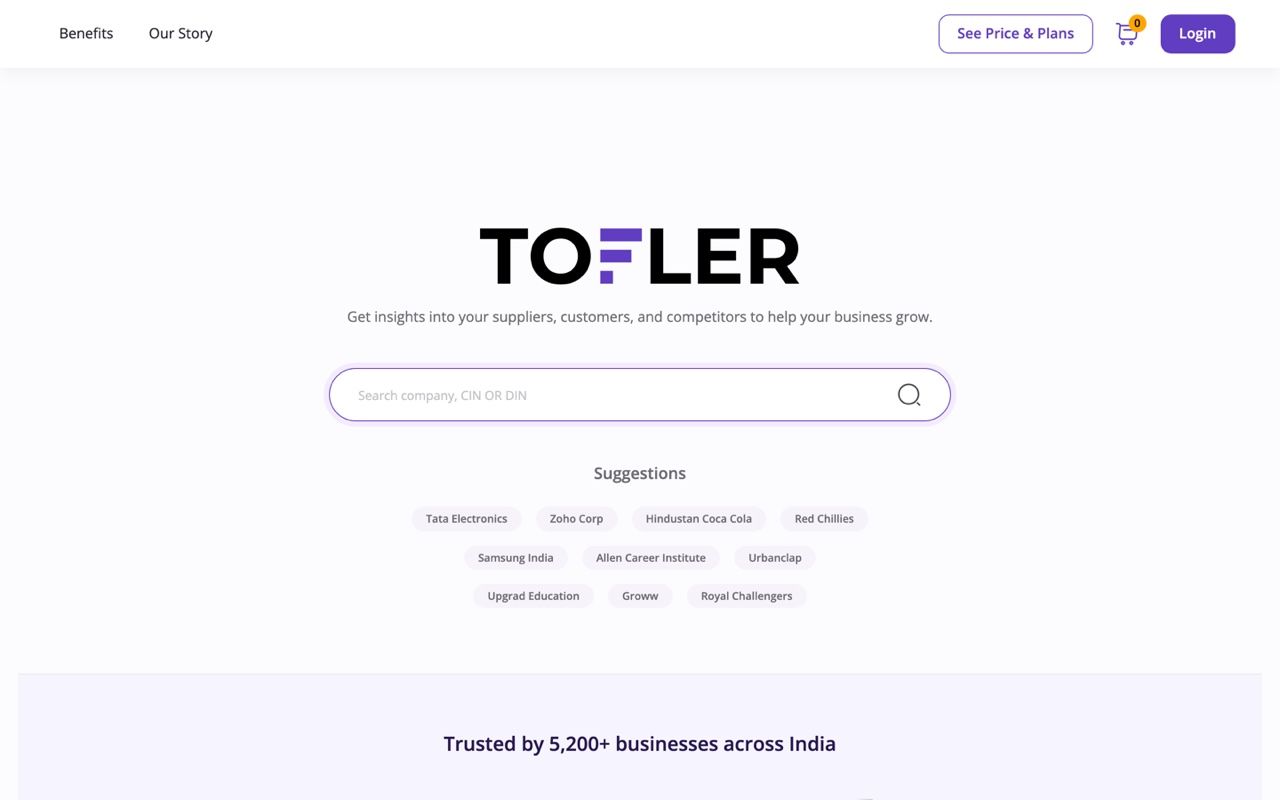
Tofler is the self-serve end of Indian company research. It says it covers over 10 million Indian businesses and is trusted by 5,200+ businesses across India. Alongside company financials and filings it offers a proprietary Tofler Score, a 62-point risk analysis, a Company Network view, a Comparator, one-click Excel and PDF exports and enterprise APIs. Its Growth plan includes what it calls advanced AI search. The model is credit-based: a credit unlocks or refreshes financial data for one company.
What makes it different: it is the shortest path from a CIN to a defensible one-page view of a company, with no procurement cycle and no sales call. The Company Network view — mapping directors across their other directorships — is the feature that earns its place in diligence, because common directorships are how you find the related entity nobody disclosed. For most Indian practices this is the single highest-value tool on this list.
Best for: CA and CS practices, SMEs and anyone doing vendor, customer or client onboarding checks in India. Natural companion to your ROC filings work and DIR-3 KYC compliance checks.
Watch-outs: credits are consumed to refresh company data, so costs scale with how many companies you look at rather than how many people use it. Model your actual volume before committing. And for anything you will sign off on — a DIN's current status, the present board — confirm against the MCA portal itself. Aggregators are as current as their last refresh of that particular company.
10. Perplexity — the free first pass
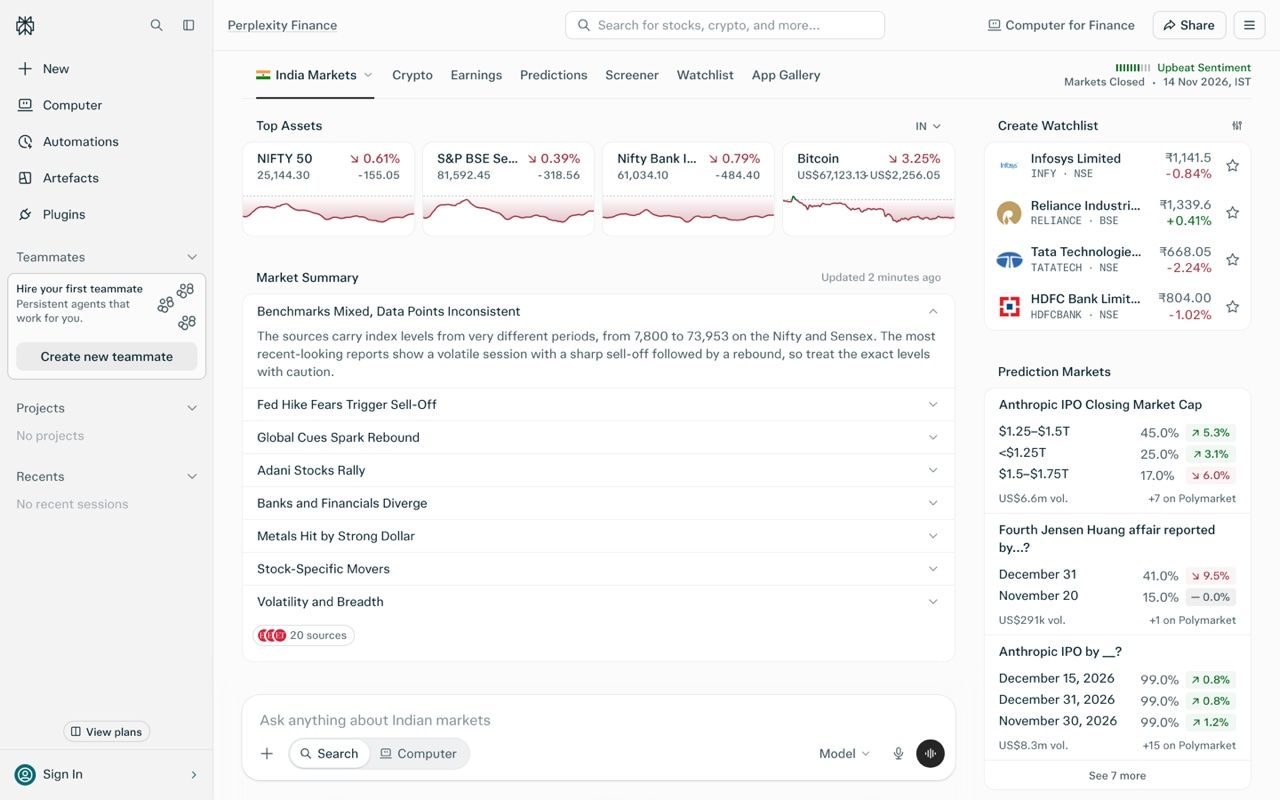
Perplexity is an AI answer engine that cites its sources inline, and it now ships a dedicated Finance surface. Opened from India it defaults to an India Markets view, with Nifty and Sensex levels, a market summary assembled from a named set of sources, an earnings calendar, a screener and watchlists. Its Deep Research mode produces longer structured research runs.
What makes it different: it costs nothing to start and nothing to abandon. Every other tool here involves a procurement decision. This one answers "is this target even worth diligencing" in twenty minutes, on a Tuesday, with no approval. For listed-company context and publicly reported history it is genuinely good, and the inline citations make it auditable in a way a plain chatbot is not.
Best for: initial scoping, background on listed companies, and summarising public controversy or litigation history before you commit budget.
Watch-outs: it has no licensed private-company data, so for an unlisted Indian company it will find very little that is reliable. Everything it tells you needs verification against a primary source before it reaches a working paper. Treat it as a starting point, never as evidence.
What this actually looks like for an Indian practice
Put bluntly: most of the platforms above are not for you. Six of the ten are priced for institutions that run transactions as their core business. That is not a reason to ignore them — knowing what the other side of the table is using is worth something — but a realistic stack for a mid-sized Indian practice is narrower.
- Baseline company research: Tofler, topped up with direct MCA portal checks for anything you sign off on.
- Scale and integration: Probe42's API once you are running enough volume that manual lookups are the bottleneck.
- Document-heavy engagements: a general-purpose AI assistant on documents you control, with Hebbia or Harvey considered only when a single engagement justifies the cost.
- Scoping and background: Perplexity, free, with everything verified downstream.
The ICAI has also made free digital audit tools available to members, which is worth checking before you buy anything — and if you are thinking about diligence work as a service line rather than a one-off, our guide on how to grow your CA firm practice covers the positioning side.
Five things to get right before you deploy any of these
- Decide where client data is allowed to go. Under the Digital Personal Data Protection Act, 2023, director details, PAN-linked identifiers and personal data in a data room are personal data processed for a stated lawful purpose. Uploading a client's documents into a consumer AI tool is a decision with consequences, not a convenience.
- Test the citations, not the answers. Every tool here will produce a fluent answer. The thing worth testing in a pilot is whether clicking the citation takes you to text that actually says what the tool claimed. Run it on an engagement you have already completed, where you know the right answer.
- Keep the primary source in the file. An AI summary is a working aid. The MCA filing, the signed contract and the bank statement are the evidence. Your file should contain the second category.
- Model the real cost. Credit-based tools cost by company looked at; seat-based tools cost by person; data rooms cost by deal. These produce wildly different bills for the same practice. Price your actual last twelve months, not a brochure scenario.
- Agree what AI did on the engagement. Where AI materially contributed to a conclusion, your working papers should say so and say what was verified by a human. That is ordinary professional documentation discipline, applied to a new tool — and it is the question a reviewer will eventually ask.
The bottom line
The ten tools here are not competing for the same slot. AlphaSense tells you what the world knows. Hebbia reads what you were given. Rogo builds the deliverable. Harvey and Luminance handle the legal estate. Datasite keeps the AI inside the room. Moody's traces the ownership. Probe42 and Tofler cover India, which almost none of the global platforms do properly. Perplexity costs nothing and is where most people should start.
If you buy one thing: AlphaSense, if your work is research-led and your budget is institutional. Tofler, if you are an Indian practice doing company checks every week — it will pay for itself faster than anything else listed, and you can be using it this afternoon.
What has not changed is the standard. These tools compress the reading. They do not transfer the responsibility. The conclusion in the report still carries your name on it.