





A client asks you to value a business whose competitors are all unlisted. A lender wants to know whether a borrower's twelve retail outlets are actually trading. You are onboarding a vendor and the only evidence of how they treat customers sits in four hundred reviews nobody has read.
None of that is in a filing. It is on the web, scattered across pages that were never designed to be read in bulk, and the traditional answer — put an article clerk on it for two days — produces a sample so small it cannot support a conclusion.
Web scraping APIs are the mechanical answer to that problem. You send a URL, the provider deals with the blocking, the page rendering and the retries, and you get structured data back. What has changed recently is the output format: a growing number of these services now return clean Markdown built to be fed straight to an AI model, which means the gap between "collect a thousand pages" and "summarise what they say" has narrowed to almost nothing.
This roundup covers ten, chosen so that each owns a distinct job. It is written for people who will have to justify the collection afterwards, so the compliance section is not an afterthought at the bottom — under India's Digital Personal Data Protection Act, 2023, it is often the part that decides whether the exercise should happen at all.
What a practice actually uses this for
Before the tools, the uses. Most scraping content is written for product teams building price-comparison sites. The work that shows up in an Indian advisory or finance practice looks different:
- Comparable company analysis. Listed comparables are easy. Unlisted ones are not, and the observable evidence — product ranges, published pricing, outlet counts, hiring — lives on websites and marketplaces.
- Vendor and counterparty checks. Registry data tells you a company exists and who signs for it. It does not tell you whether customers are being left unanswered or whether the trading name has quietly changed.
- Monitoring an exposure over time. A single snapshot is an anecdote. The same twenty pages captured weekly for six months is evidence, and that only works if the collection is automated.
- Market and pricing intelligence. For transfer pricing benchmarking, valuation support or a client's expansion plan, published prices across a market are a legitimate and often under-used input.
All four are collection problems first. That is what these ten tools solve.
How we chose these ten
- It must be an API or a self-hosted equivalent, not a point-and-click desktop scraper. The assumption is that something downstream — a model, a spreadsheet, a workflow — consumes the output automatically.
- It must own a distinct job. Raw page fetching, structured search results, entity extraction and AI-ready Markdown are genuinely different problems. One entry per problem.
- It must be verifiable. Every figure below comes from the vendor's own site, checked in November 2026.
A warning about benchmarks. Almost every "success rate" in this market is published by a vendor or by a competitor, and they contradict each other outright. Zyte's site cites a December 2025 Proxyway test putting Zyte at 97.82% and Bright Data at 94.65%. Bright Data's blog cites a different 2026 benchmark putting Bright Data at 98.87%. Firecrawl publishes 96% coverage on a 1,000-URL benchmark it built and ran itself. These cannot all be the neutral truth. Treat every number here as a vendor claim — which is how you would treat a number in any other unaudited document — and run your own test before committing. Most of these services have a free tier precisely so you can.
The short version
| API | The one thing it is for | Typical use in a practice |
|---|---|---|
| Bright Data | Hard targets and maintained scrapers for named sites | Marketplace and listing data at scale |
| Apify | Ready-made scrapers plus scheduling and storage | Recurring monitoring without a developer |
| Firecrawl | Feeding an AI model clean Markdown | Summarising large volumes of pages |
| Zyte API | Lowest cost per successful response at volume | Large one-off collection exercises |
| Oxylabs | Enterprise infrastructure and certifications | Work that must pass a vendor review |
| ScraperAPI | Simple, cheap, high-volume page fetching | Straightforward sites in bulk |
| ScrapingBee | Transparent credit pricing at small scale | A single engagement with a known budget |
| Diffbot | Entities and relationships, not pages | Company and director intelligence |
| SerpApi | Structured search engine results | Local presence, reputation, litigation traces |
| Crawl4AI | Running it yourself for nothing | Low-volume internal projects |
Our top recommendation
Bright Data is the strongest general-purpose choice, for a reason that matters more than benchmark scores: someone else maintains the scraper. For the work described above the target is usually a well-known site — a marketplace, a review platform, a job board — and Bright Data already keeps a parser running against it. When that site changes its markup, the repair is their problem, and because failed requests are not billed, a broken scraper costs them rather than you.
Two honest qualifications:
- If cost per successful request decides it, Zyte is cheaper — from $0.06 per 1,000 successful responses at a $500 monthly commitment, against Bright Data's $1.50 per 1,000 records pay-as-you-go.
- If the output goes straight to an AI model, Firecrawl fits better than either, because it emits clean Markdown rather than HTML you must strip first.
1. Bright Data — breadth, and someone else maintaining the scraper
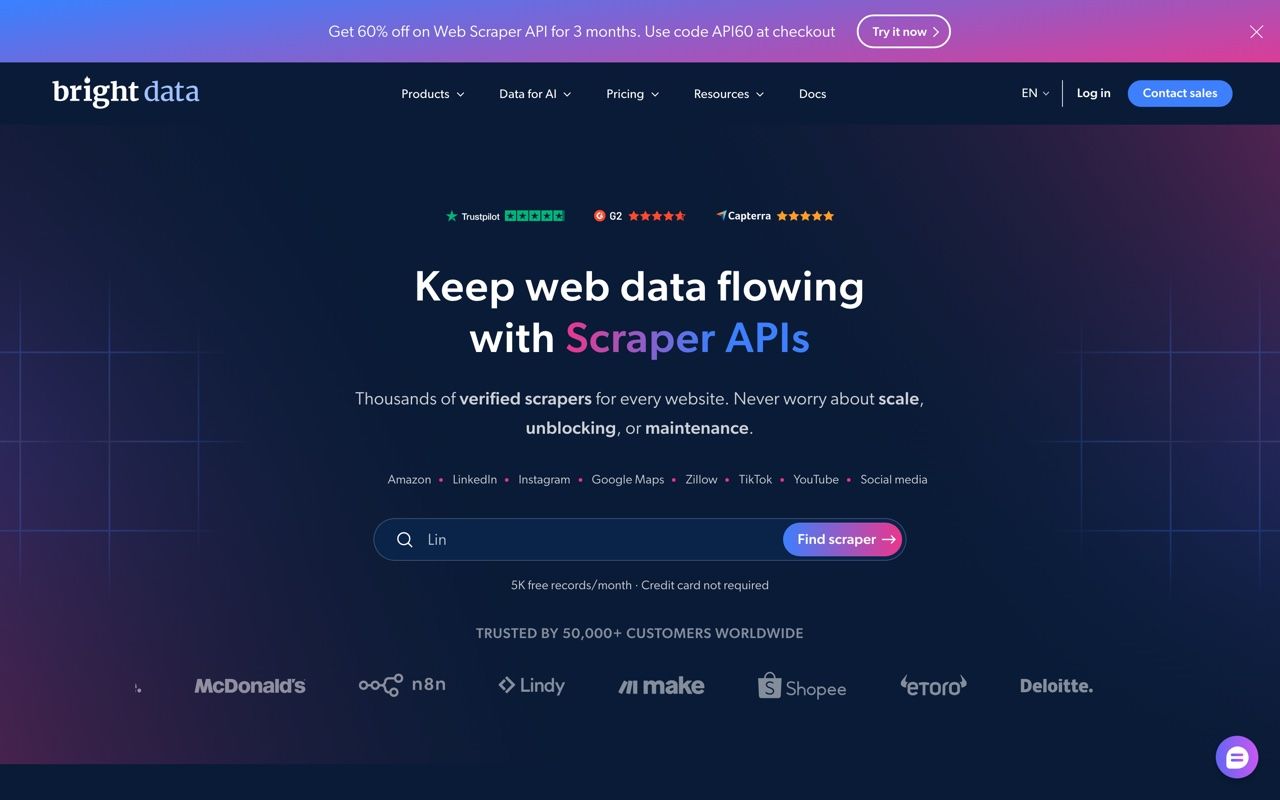
Bright Data's Web Scraper API is sold on coverage. Its FAQ cites 1,400+ pre-built scrapers for popular sites, with e-commerce coverage spanning 800+ domains — though the headline on the same page says "thousands", and the two figures are inconsistent, which is itself a useful reminder about vendor numbers. Behind it sits a residential network the company puts at 400M+ IPs. A single API call accepts up to 5,000 target URLs, and Scraper Studio builds custom scrapers for sites with no pre-built option.
Why it matters here: for comparable company work, the evidence is concentrated on a handful of large platforms. Being able to pull structured marketplace listings or review histories without writing or maintaining a parser is the difference between this being a service line and being a one-off favour.
Pricing: 5,000 free records a month, $1.50 per 1,000 records pay-as-you-go, Scale at $499 a month including 384,000 records. The company reports 50,000+ customers and holds ISO 27001 certification with SOC 2 controls — relevant if a client asks where their data went.
Watch-outs: not the cheapest per request, and the pricing model takes some reading. Compliance review of use cases is part of their onboarding, which is reassuring but adds time.
2. Apify — recurring collection without a developer
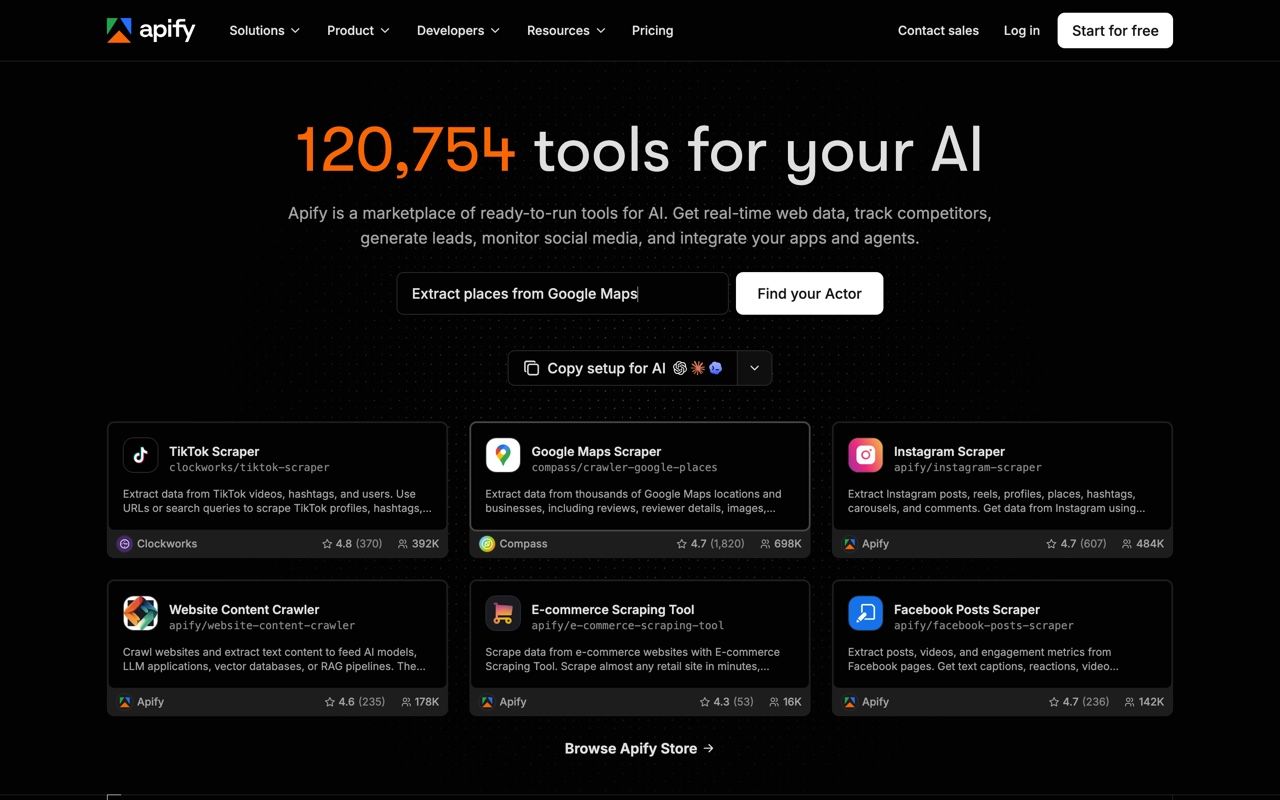
Apify is a marketplace of ready-to-run tools. Its unit is the Actor: a cloud program that takes JSON in and returns structured data. At the time of writing its homepage counter showed 120,754 tools available. Around that sits a genuine platform — scheduling, storage, proxies, and a hosted MCP server so AI agents can run Actors directly.
Why it matters here: this is the entry that fits a practice with no engineering team. "Capture these 300 listings every Monday and keep the history" is a configuration, not a project, and the history is the part that turns collected data into evidence. If you are already looking at accounting automation, this is the same instinct applied to external data.
Watch-outs: much of the catalogue is community-built, so quality varies — check the rating and maintainer before depending on one. Pricing mixes platform usage with per-Actor charges, so model it before committing.
3. Firecrawl — built for what the model needs
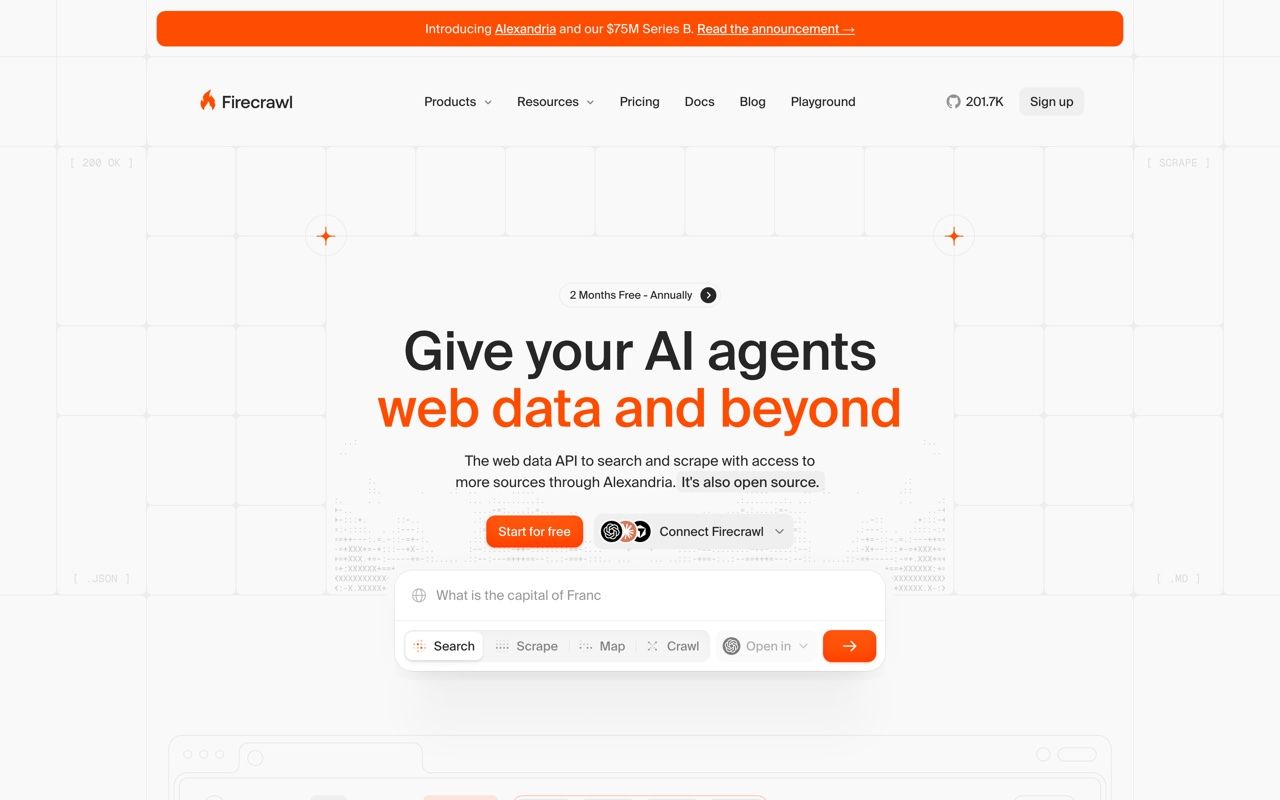
Firecrawl is designed around AI models rather than parsers. It exposes scrape, crawl, map, search and extract operations and returns Markdown, JSON or screenshots. Its site reports 150,000+ companies using it and a GitHub star count of 201.7K, and the project is open source. It publishes a benchmark it ran itself on 13 January 2026 over 1,000 URLs, claiming 96% coverage against Puppeteer at 79% and cURL at 75%, with P95 latency of 3,387ms. It also claims 93% fewer input tokens by stripping navigation, footers and ads before content reaches your model.
Why it matters here: this is the one that closes the loop on "read four hundred reviews". Collect the pages as Markdown, hand them to a model, ask a consistent question of each. The token argument is not marketing — raw HTML inflates cost and buries the content, which degrades the answer you get back.
Watch-outs: independent tests have been markedly less kind to Firecrawl on protected sites than its own benchmark. For documentation, blogs and ordinary content sites it is excellent; for aggressively defended targets, test it hard first.
4. Zyte API — cheapest per success, if you commit
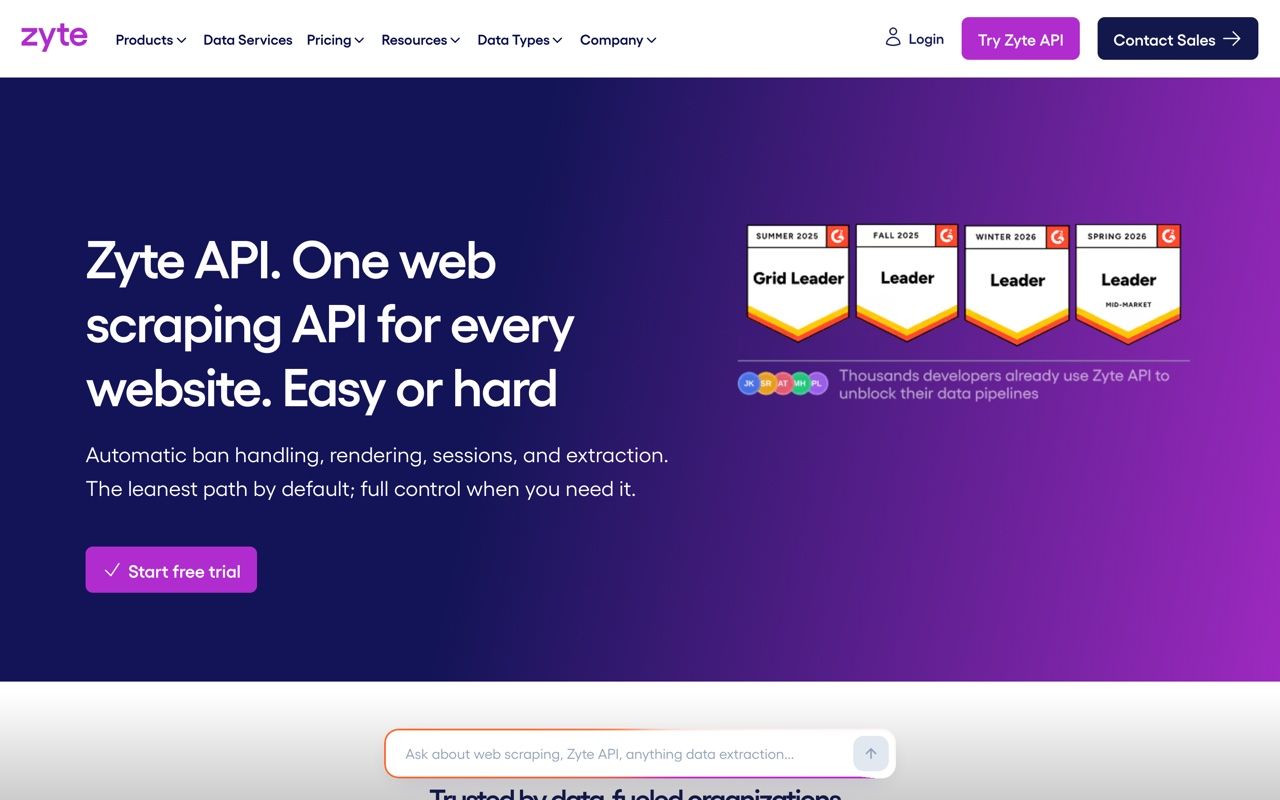
Zyte puts the whole stack behind one endpoint: headless browser, IP rotation across residential, datacentre and mobile pools, AI extraction from raw HTML, session management, scripted actions and geo-targeting. Its distinctive mechanic is automatic ban handling — it describes adjusting request patterns, proxies and fingerprinting per site, and choosing the leanest set of proxies a site actually requires.
Why it matters here: that last point is the pricing model in disguise. Most providers route everything through expensive residential IPs; Zyte tries the cheapest method that works and escalates only when forced. Hence a headline rate as low as $0.06 per 1,000 successful responses at a $500 monthly commitment, against pay-as-you-go HTTP rates of $0.13 to $1.27 per 1,000 and browser-rendered rates of $1.01 to $16.08. For a large one-off exercise — a market-wide price capture for a benchmarking study — that spread decides the budget.
Watch-outs: pricing is tiered on both volume and method, so a site that forces browser rendering costs an order of magnitude more. Model your actual target mix. There is $5 of free credit to do exactly that.
5. Oxylabs — the one that passes a vendor review
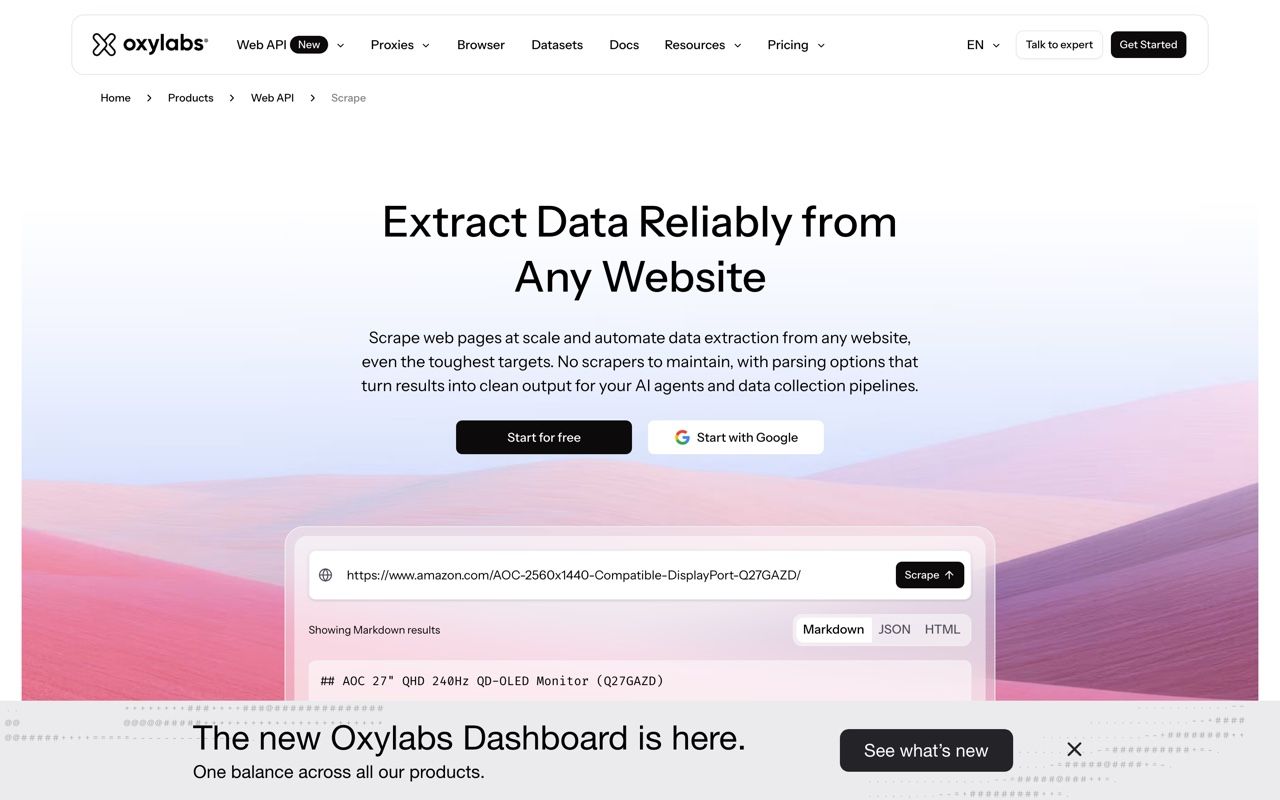
Oxylabs came from the proxy side and layered scraping on top. Its Web Scraper API reports 177M+ proxies across 195 countries and 99.9% API uptime, with 11+ years in the business. It returns raw HTML, Markdown, JSON or screenshots, offers target-specific parameters for Google, Amazon and Walmart, and has added MCP and Agent Skills. It holds ISO/IEC 27001:2022 and SOC 2 Type II.
Why it matters here: if the client is a bank, an NBFC or a listed company, the question will not be "how good is the data" but "who is this vendor and what are they certified to". Oxylabs is among the few here that answers that without friction. The 195-country footprint also matters for genuinely cross-border work.
Pricing: Starter $15 a month, Basic $100, Flexible $500, Enterprise from $2,500. Pay-as-you-go scraping from $0.50 per 1,000 results, falling to $0.25 at very high volume; AI parsing at $3.00 per 1,000 parsed pages.
Watch-outs: enterprise packaging. The entry plan works for a single user, but you are paying into an infrastructure story you may never need.
6. ScraperAPI — the uncomplicated workhorse
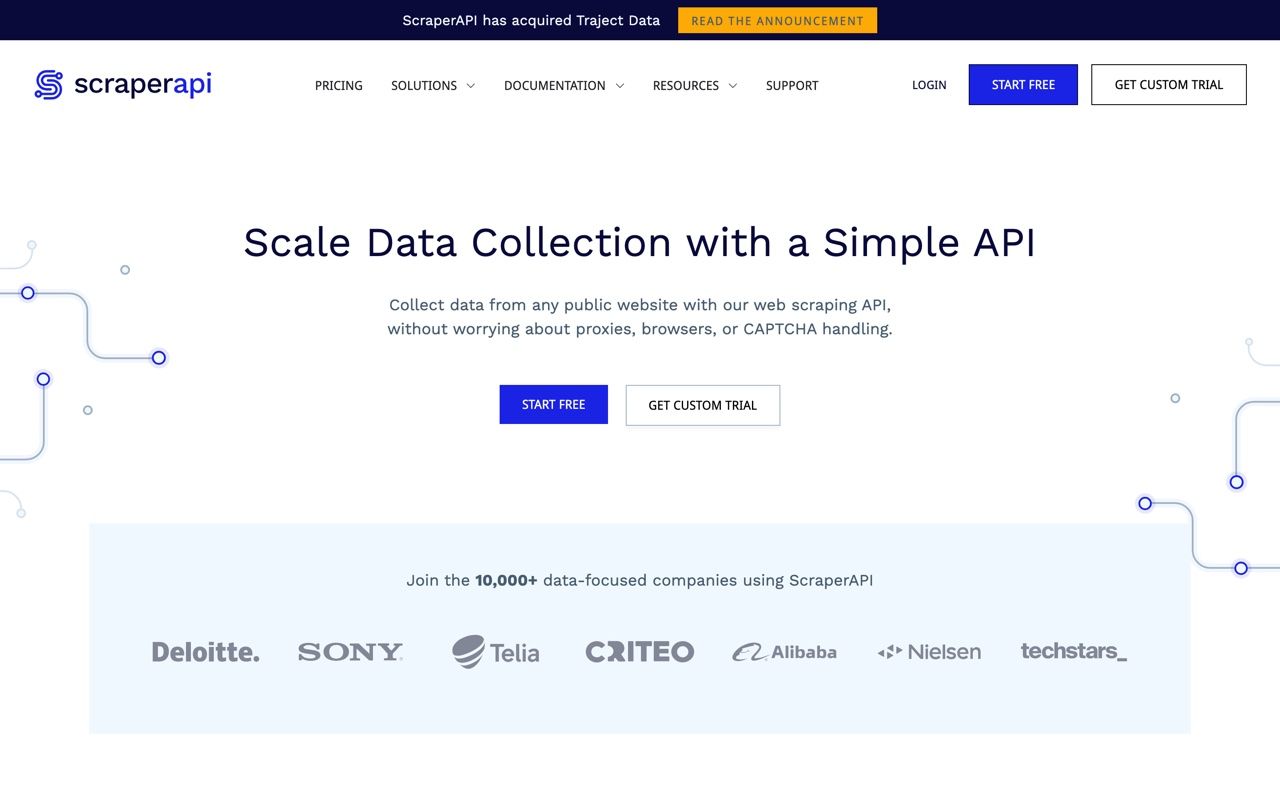
ScraperAPI is deliberately plain: send a URL, get the page, with proxies, browsers and CAPTCHAs handled. It reports a pool of over 40 million proxies across 50+ countries, 10,000+ companies using it, and over 11 billion requests served in the last 30 days. Beyond the basic endpoint there are structured endpoints returning JSON for popular domains such as Amazon Product, Google Search and Walmart Search, an Async Scraper for very large batches, a no-code DataPipeline, and an AI Parser.
Why it matters here: it is the one a competent generalist can integrate in an afternoon. No platform to learn, no vocabulary to absorb. For a high volume of ordinary pages — company websites, directory listings — that simplicity is the feature.
Watch-outs: no pricing on the homepage, so you will need the pricing page or a conversation. Credit consumption rises for JavaScript rendering and protected sites, so headline credit counts overstate how many difficult pages you actually get.
7. ScrapingBee — honest pricing at small scale
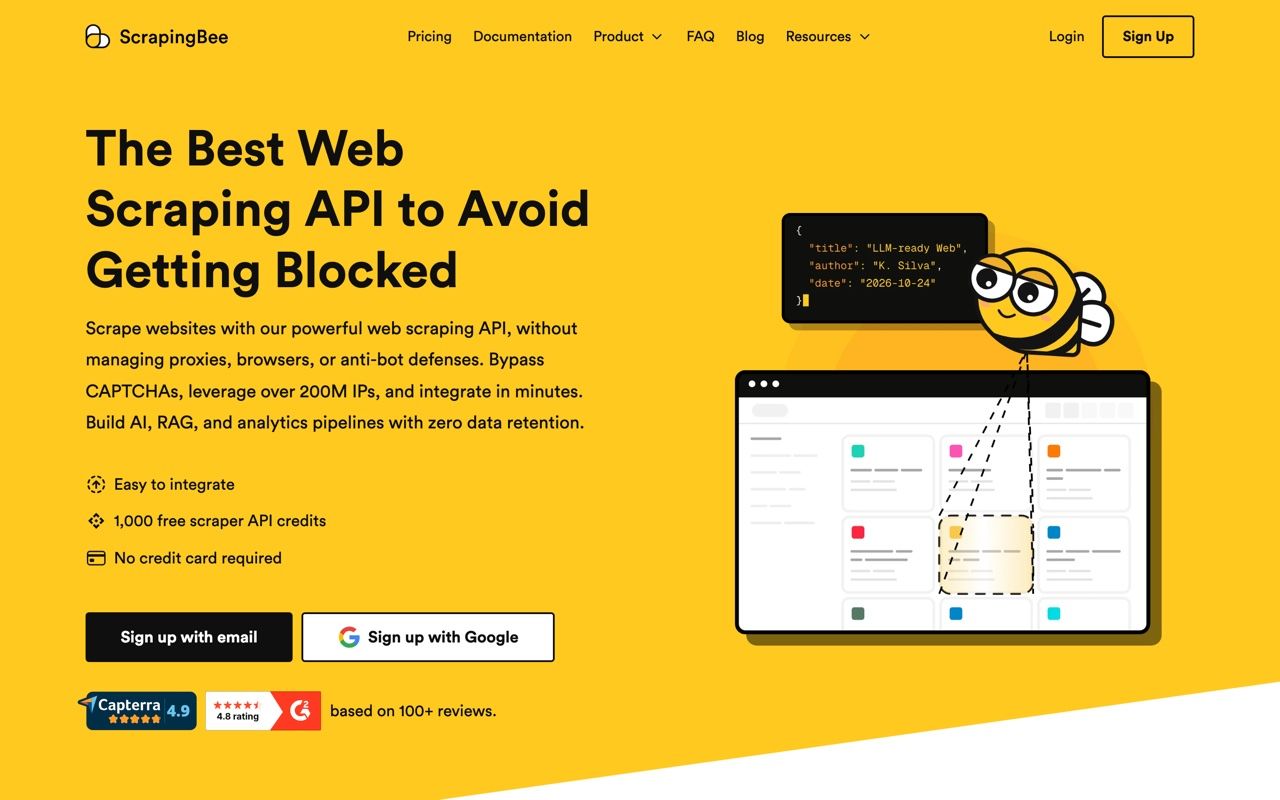
ScrapingBee covers similar ground with unusually clear packaging: an HTML API, AI Data Extraction where you describe the fields you want in plain language, a Markdown Scraper, screenshots, a JavaScript Scenario engine for clicks and form fills, and CSS/XPath extraction. It offers dedicated APIs for Google Search, Amazon, Walmart, YouTube and others, and says it can leverage over 200M IPs with geotargeting across 200+ countries.
Why it matters here: it tells you what things cost. JavaScript rendering is 5 credits per successful request; premium proxies 10 or 25. Plans run from Hobby at $19 for 75,000 credits to Business+ at $599 for 8 million, and a successful request is defined as one returning HTTP 200, 404 or 410 — failures are not charged. If you need to quote a client a fixed cost for a collection exercise, published multipliers are what make that possible.
Watch-outs: those same multipliers mean a plan sized in millions of credits may only cover a few hundred thousand difficult pages. Do the arithmetic before choosing a tier. The 99% success figure is the vendor's own.
8. Diffbot — entities instead of pages
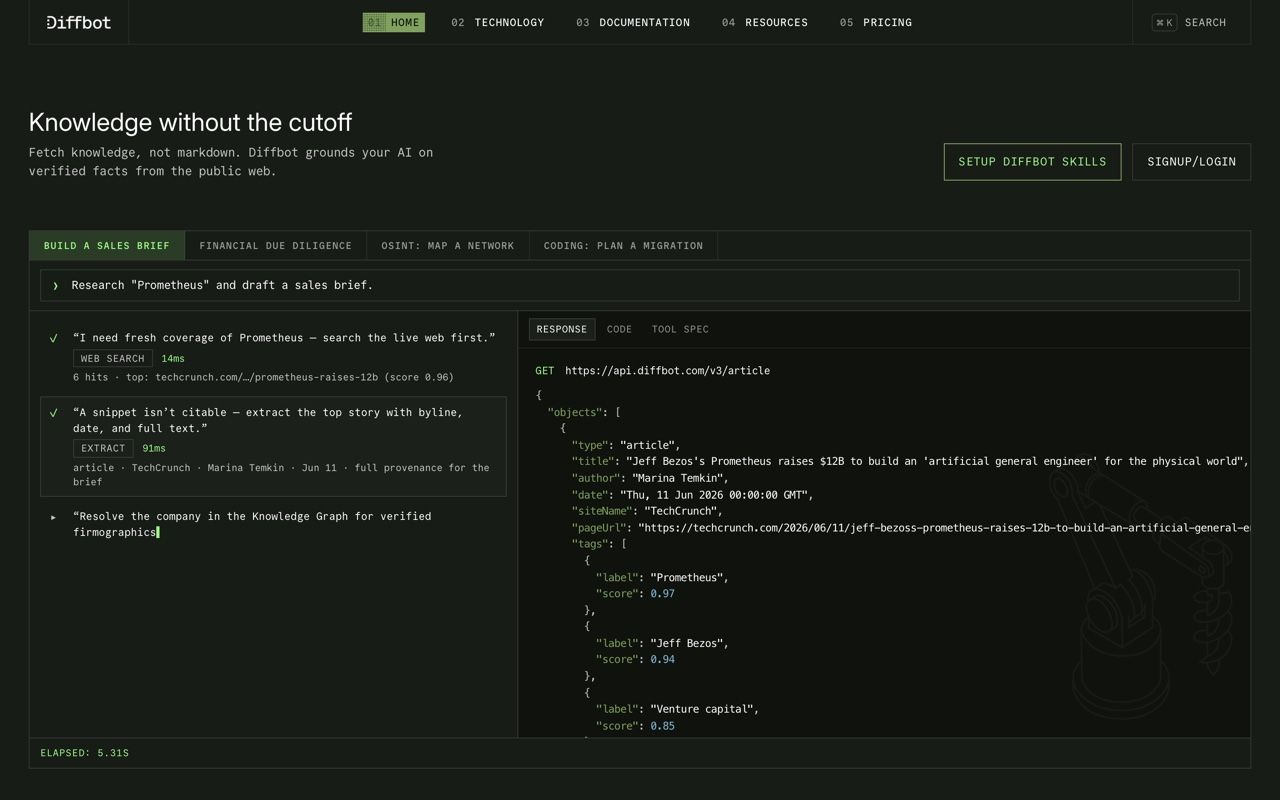
Diffbot is the odd one out, deliberately. Alongside Extract, Crawl and Natural Language APIs it maintains what it calls the world's largest Knowledge Graph of the public web, covering companies, people and news, queried with structured queries rather than by crawling. Its Extract API classifies a URL and returns structured JSON, and Diffbot is explicit that this is not an LLM and returns results "without hallucinations". Its Web Search product claims sub-300ms P90 latency from a packaged index of 4TB against the 150TB of web it cites.
Why it matters here: every other tool answers "what is on this page". Diffbot answers "what do we know about this company". For counterparty work that is the whole point — you want an entity with attributes and relationships, not a hundred documents to reconcile by hand. It pairs naturally with the registry-based platforms in our roundup of AI tools for company research and due diligence, which cover the MCA side that Diffbot does not.
Watch-outs: the most expensive category here, and a poor fit if you need one specific page rather than an entity. Note too that Diffbot's own published comparison shows it at 0.65 on accuracy against Exa at 0.8 — a vendor conceding a competitor's lead is worth reading rather than skipping.
9. SerpApi — search results as structured data
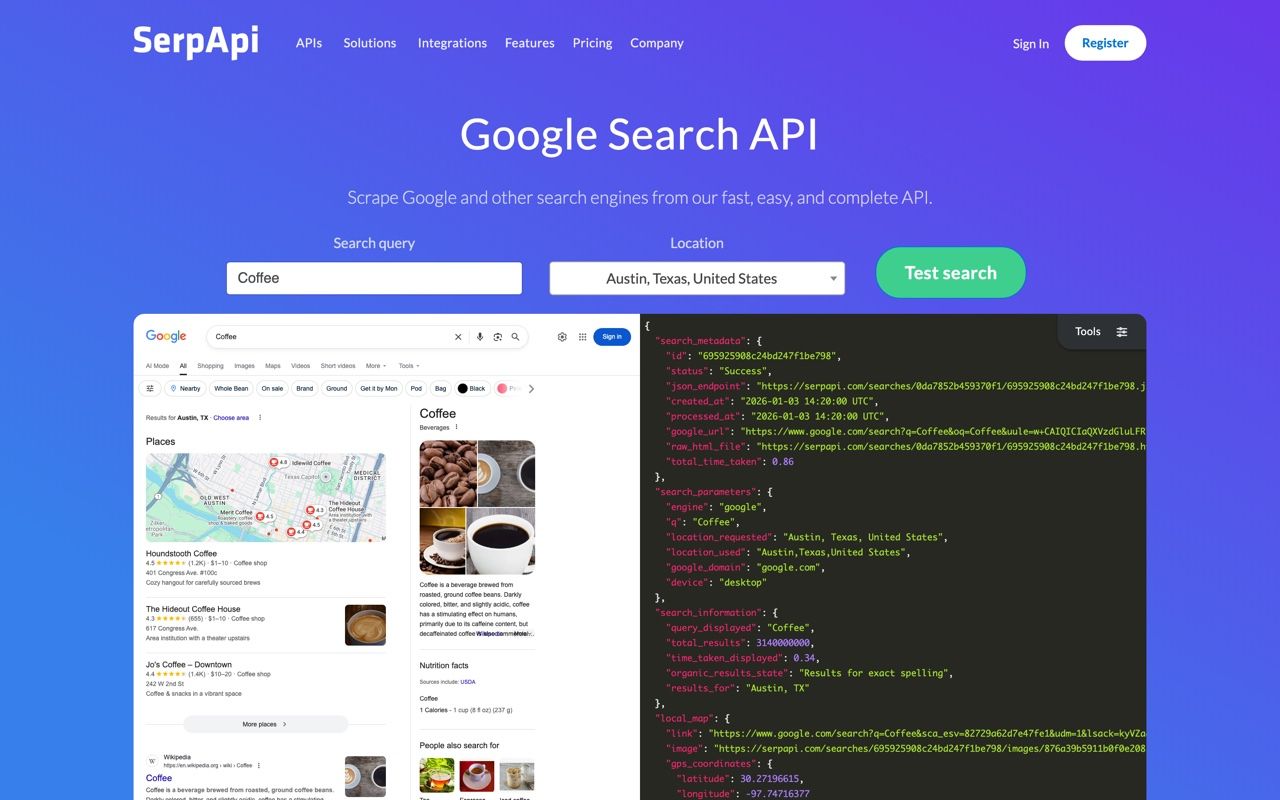
SerpApi does one thing: it returns search engine results as clean JSON. It covers Google and its verticals — Maps, Images, News, Shopping, Scholar — plus Bing, Baidu, Brave, DuckDuckGo, Naver, Yahoo and Yandex, and marketplace search on Amazon, eBay, YouTube and Walmart. Each request runs in a full browser and the company says it solves CAPTCHAs itself. It cites a 99.95% SLA on all plans.
Why it matters here: Maps results are the cheapest reliable way to test whether a borrower's claimed outlets exist, carry reviews and look active. News and web results surface adverse media and litigation traces that no registry holds. And SerpApi is the only entry offering a US Legal Shield — described as up to $2 million in coverage, included from the Production plan upward — for the scraping and parsing of search engine data. The coverage is explicitly about collection, not about what you then do with the data, but for a regulated client that distinction is still worth something.
Pricing: free at 250 searches a month, then Starter $25 for 1,000, Developer $75 for 5,000, Production $150 for 15,000, Big Data $275 for 30,000. Only successful searches count.
Watch-outs: per-search pricing is high relative to page scraping, because you are paying for parsed SERP data. If you need raw pages, this is the wrong tool.
10. Crawl4AI — the free one you host yourself
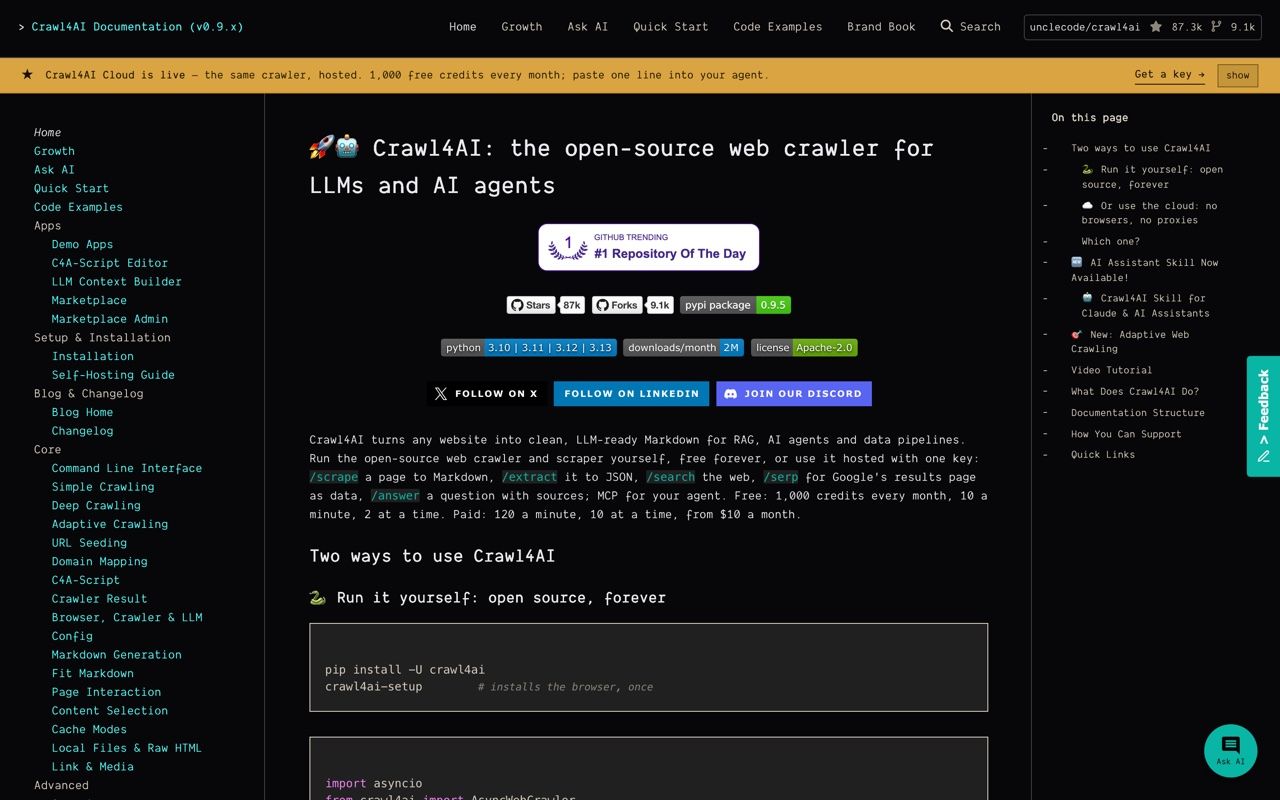
Crawl4AI is an open-source crawler under the Apache-2.0 licence that turns websites into AI-ready Markdown. Its documentation reports 87.3k GitHub stars, 9.1k forks and around 2 million downloads a month, and it has held the top spot on GitHub Trending. You install it with pip, self-host with Docker, or use Crawl4AI Cloud, which offers 1,000 free credits a month at 10 requests a minute, with paid plans from $10 a month. It exposes scrape, extract, search, serp and answer operations, plus MCP for agents.
Why it matters here: for an internal project with modest volume and ordinary targets, the marginal cost of a page is your own compute. It is also the only entry where you can read exactly what the extraction does — which, if you ever have to explain your methodology to a reviewer, is not a trivial advantage.
Watch-outs: self-hosting means you own the proxies, the bans and the breakage — precisely the work the other nine sell you out of. Use it where targets are friendly and reach for a commercial API the moment you hit serious bot detection.
Choosing without regret
The useful question is not which API is best, but which of four jobs you have.
- A named site scraped reliably, indefinitely. Bright Data or Apify — someone else maintains the parser.
- Pages turned into model input. Firecrawl, or Crawl4AI if the budget is zero.
- Rankings, local listings or adverse media. SerpApi.
- A very large volume of ordinary pages. Zyte or ScraperAPI.
Then run the same twenty target URLs through the two finalists on their free tiers and compare what comes back. That one afternoon will tell you more than every benchmark in this article, including the ones quoted here.
The part that decides whether you should collect at all
For a professional practice this is not the closing caveat. It is the first question, because you may have to defend the collection long after the engagement closes.
- Personal data stays personal data. Under the Digital Personal Data Protection Act, 2023, information about an identifiable individual remains regulated even when it was scraped from a public page. Names, phone numbers, email addresses and director details collected into a list are the highest-exposure use case here, and "it was publicly visible" is not by itself a lawful basis.
- Purpose limitation applies before collection, not after. Decide what each field is for and how long you will keep it before the first request goes out. If you cannot state the purpose of a field in one sentence, do not collect it — that is the cheapest control available.
- Terms of service are a separate question. Many sites prohibit automated collection contractually, which is a contract issue independent of data protection. Our note on contract law in the digital age is a useful starting point.
- Respect robots.txt and rate limits. Beyond etiquette, aggressive crawling that degrades a site invites a far more serious characterisation of what you were doing.
- Copyright does not evaporate. Facts are generally not protected; the expression of them often is. Analysing scraped text is a different act from republishing it.
- Record the method in the file. If scraped data supports a conclusion in a report, your working papers should say what was collected, from where, on what date and by what means. That is ordinary documentation discipline applied to a new source — and it is the question a reviewer will eventually ask.
For clients operating online, the obligations around collected data increasingly intersect with tax and reporting — see our note on digital tax proposals for e-commerce businesses.
The bottom line
Bright Data wins on breadth and is the safest single choice. Zyte wins on cost per successful response at volume. Firecrawl wins when an AI model is the consumer. Diffbot wins when you want entities rather than pages. SerpApi wins for search results and adverse media, and is alone in offering cover for the collection itself. Crawl4AI wins when the budget is nothing and the targets are soft.
The collection problem is solved and has been for a while. What no vendor removes is the judgement about what you are entitled to gather and whether the conclusion it supports is sound — the same judgement you apply when choosing any software that touches client data, or when building a service line that depends on it.